
Self-Employed and Company Director Mortgages Explained
There's a myth that being self-employed makes getting a mortgage hard. It doesn't. It makes it different, and the difference is that the number a lender treats as your income often bears very little relation to the money you actually have.
I'm a qualified accountant as well as a mortgage adviser, so this is the part of the job I find most interesting, and the part where the right lender choice makes the biggest difference to what you can buy.
"Self-employed" means three different things
Lenders split it up:
Sole traders and partners are assessed on net profit, or your share of it. That's the figure on your tax return, before tax, after allowable expenses.
Company directors owning a stake in the business, usually 20% or 25% and above depending on the lender, are treated as self-employed even though you pay yourself through PAYE. This surprises people every week.
Contractors working through their own company or an umbrella sit somewhere in between, and a number of lenders will assess a contractor on their day rate rather than their accounts, which is often far more generous.
How many years of accounts you need
Two years is the common answer. Some lenders will work with one full year of trading, particularly if you were doing the same work as an employee beforehand. A smaller group will consider less than that in specific circumstances.
Where two years are available, lenders differ on what they do with them. Some average the two. Some use the most recent year. Most will use the lower of the two if your figures are falling, so a bad year followed by a good one is fine, and a good year followed by a quieter one is the harder conversation.
The bit that costs directors the most money
If you run a limited company, this is the section to read twice.
Most lenders assess a director on salary plus dividends. That is, the money you actually took out of the company.
A minority assess you on salary plus your share of the company's net profit, whether you drew it or not.
The difference is enormous. Take a director paying themselves a £12,570 salary, drawing £20,000 in dividends, and leaving the rest in the company. The company makes £80,000 in net profit after that salary and before corporation tax.
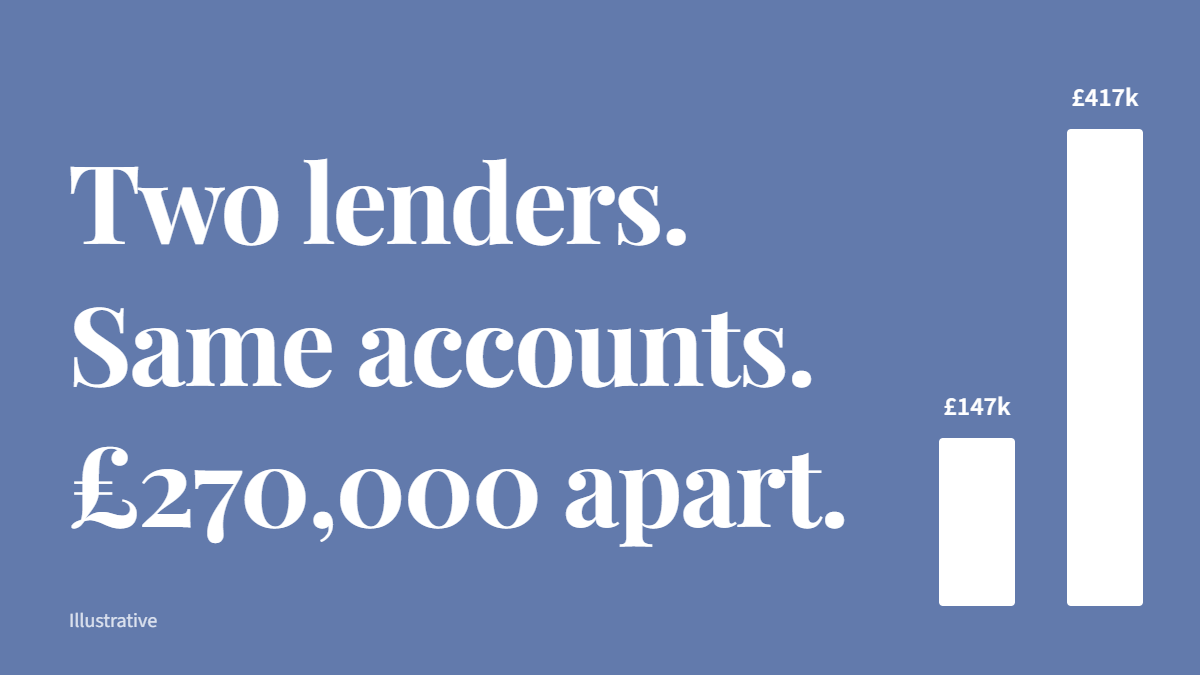
A salary-plus-dividends lender sees an income of £32,570. At four and a half times, that's around £146,565 of borrowing.
A salary-plus-net-profit lender sees £92,570. At the same multiple, around £416,565.
Same person. Same company. Same year. A difference of roughly £270,000 in what they can buy, decided entirely by which lender's form the application lands on. (Both figures are illustrative, and affordability checks still apply on top of the multiple.)
Why your accountant and your mortgage pull in opposite directions
Your accountant's job is to reduce your taxable profit. That's what a good one does, and it saves you real money.
The mortgage market reads taxable profit as your income.
So the more effectively your accounts are structured for tax, the smaller you look to most lenders. Neither party is doing anything wrong. They're just optimising for different things, and nobody tells you they're in tension until you apply.
You don't have to pick one. You do have to plan. If you're thinking about buying in the next couple of years, that's a conversation to have with your accountant and your adviser at the same time, well before the accounts are filed, not the week you find a house.
The one thing not to do is restructure your accounts in a hurry the month before applying. Lenders look at two years, so a sudden change is visible and it raises more questions than it answers.
Two myths worth clearing up
The first is that self-employed people pay higher interest rates. They don't. There is no separate range of expensive products for the self-employed. You apply for the same rates as everybody else, and the only thing that differs is how the lender arrives at your income figure. If you're being offered something noticeably more expensive because you work for yourself, that's a reason to get a second opinion.
The second is that you need a bigger deposit. Also untrue as a rule. The usual loan-to-value bands apply to you the same way they apply to an employee. Where a larger deposit does help is that it reduces the loan you need, which makes the affordability sums easier if your assessed income is on the low side.
What if you've only just started?
Going from employed to self-employed doing broadly the same work is the strongest version of this story, and several lenders will treat it sympathetically. If you were a salaried electrician and you're now a self-employed electrician, one year of accounts plus evidence of your employment history beforehand is often enough.
Starting something genuinely new is harder in year one, and the honest answer is that waiting until you have a full set of accounts will usually get you a better outcome than pushing an application through early. If you're in that position, the useful thing is to plan the timing rather than test the market.
What to have ready
- Tax calculations (SA302s) and tax year overviews for the last two or three years
- Full accounts, ideally prepared or signed off by a qualified accountant
- Three months of personal and business bank statements
- Your accountant's name and contact details, as some lenders write to them directly
- If you're a contractor, a copy of your current contract and evidence of your renewal history
Where I come in
I can read a set of accounts, and I know which figure each lender will pull out of them. That means I can tell you what you're likely to be offered before you apply, rather than after a decline lands on your credit file.
I'm independent, so I'm searching the whole market rather than the handful of lenders on somebody's panel. For self-employed applicants that matters more than it does for anyone else, because the spread between the most and least generous lender is at its widest here.
Your home may be repossessed if you do not keep up repayments on your mortgage.