
How Much Deposit Do You Need to Buy Your First Home?
Most first-time buyers I speak to arrive with a number in their head that somebody gave them in a pub. Twenty per cent deposit. Forty grand. Come back in five years.
That number is usually wrong, and it's usually too high. Here's what buying a first home actually costs.
The deposit
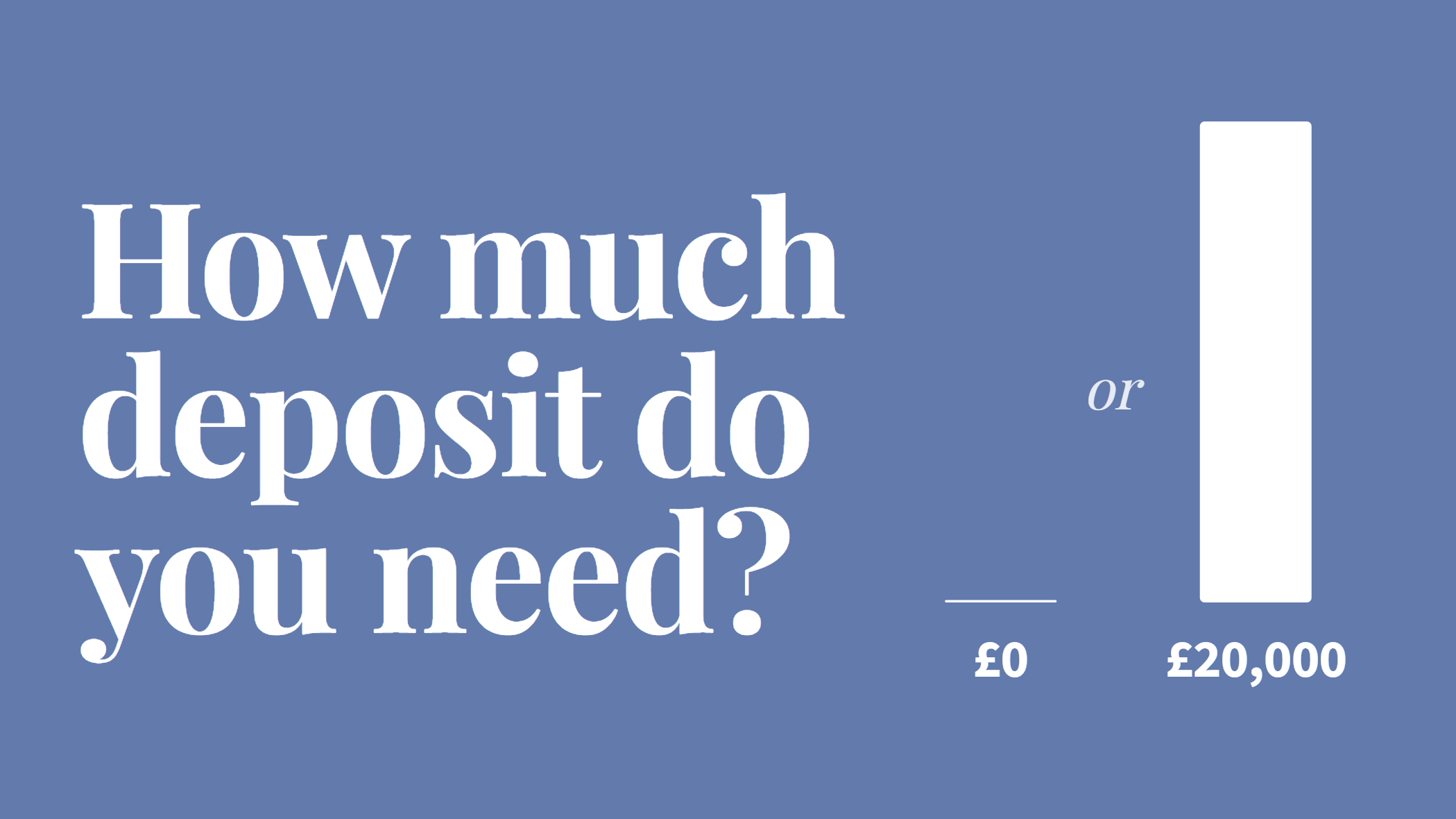
The standard answer is 5% of the purchase price. On a £200,000 home that's £10,000, not £40,000.
The less standard answer is that there are now products requiring 2%, and some requiring nothing at all.
What changes as your deposit grows is the interest rate, not whether you can buy at all. Lenders price in bands based on loan to value, which is the size of the loan as a percentage of the property price. The bands usually sit at 95%, 90%, 85%, 80%, 75% and 60%. Every band you drop into typically buys you a lower rate.
The jump from a 5% deposit to a 10% deposit is normally the one worth waiting for, because the difference in rate between those two bands tends to be wider than the gaps further down. On a £190,000 loan, a rate difference of half a per cent is roughly £50 a month. Beyond a 25% deposit, the improvements get small.
If you have very little saved
Three routes exist that most first-time buyers don't know about, and none of them require the 20% figure people quote at you.
A fixed £5,000 deposit, whatever the price. A small number of lenders offer products where the deposit is a flat £5,000 rather than a percentage. On a £250,000 home that's 2%. The conditions vary between them: some require the money to be your own savings rather than a gift, some allow family gifts, and each sets its own minimum and maximum property value.
No deposit at all. At least one lender offers a 100% mortgage aimed at renters, assessed on your record of paying rent and household bills on time for at least 12 months. You need to have not owned a property in the last three years, and there's a cap on the property value.
A £10,000 minimum on a house. Another route allows up to 98% of the price with a minimum £10,000 deposit, restricted to houses rather than flats, and to employed rather than self-employed applicants.
What the low-deposit routes cost you
They're real options and they've put people in homes who'd otherwise still be renting. They also come with trade-offs that deserve saying out loud, because nobody advertising them will:
- The rate is higher than you'd get with a larger deposit, in some cases considerably
- Most of them require a five-year fixed rate, so you're committing for longer
- The income multiple is usually capped lower than standard, often around four and a half times, so you can borrow less relative to your income than a buyer with a 10% deposit
- Almost all exclude new-build properties, and some exclude flats
- You start with little or no equity, so if prices fall you could owe more than the property is worth, and your choices at the end of the fixed period may be limited until you've built some equity back up
That last point is the one to think hardest about. Buying with no deposit isn't wrong, and for someone paying rent that exceeds a mortgage payment it can be clearly the better financial decision. It's just a different risk profile from buying with 10% down, and you should go in knowing which one you've chosen.
Whether any of these fit depends on the property, your income, your employment and where the money is coming from. It's worth a conversation before you conclude you need another two years of saving.
How much you can borrow
The rough starting point across most of the market is four and a half times your income. On a £35,000 salary that's about £157,500. For a couple earning £35,000 and £28,000 between them, roughly £283,500.
Some lenders will go higher. There are schemes that stretch to five and a half times income, and a few that go further again for higher earners or particular professions. They come with their own rules: minimum income, maximum loan to value, first-time buyers only, employed applicants only. Which of them you qualify for is one of the things worth getting advice on, because the difference between four and a half times and five and a half times your income is around £35,000 of buying power on a £35,000 salary.
The multiple is only the ceiling. Underneath it, the lender runs an affordability assessment on your actual outgoings: credit cards, car finance, loans, childcare, student loan repayments, and how you spend month to month. A car finance agreement at £300 a month can cost you tens of thousands of pounds of borrowing capacity. If you're planning to buy within the next year, that's worth knowing before you sign anything.
The costs nobody adds up
This is the part that catches people out, and it's the part I look at hardest.
Stamp duty. In England and Northern Ireland, first-time buyers pay nothing on the first £300,000 and 5% on any amount between £300,000 and £500,000. Above £500,000 the relief disappears completely and standard rates apply to the whole purchase. Every buyer named on the purchase has to be a first-time buyer for the relief to count. Scotland and Wales have their own systems, Land and Buildings Transaction Tax and Land Transaction Tax, with different thresholds.
Legal fees. Budget £1,000 to £2,000 including searches and Land Registry charges.
Survey. A basic valuation may be included by your lender. A homebuyer's report costs somewhere around £400 to £900, and a full building survey more. On an older property this is money well spent.
Mortgage product fee. Often £999 or so, sometimes nothing. It can usually be added to the loan, though you then pay interest on it for the life of the mortgage.
Moving and the first month. Removals, a new washing machine, and the fact that your first month in the house always costs more than you planned.
On a £200,000 purchase with a 10% deposit, a realistic all-in figure is around £20,000 deposit plus £2,000 to £3,000 of costs. Not £40,000, but not £20,000 either.
What lenders look at besides the money
Your credit file matters more than most people expect, and not in the way they expect. A thin file with no borrowing history can be as much of a problem as a few late payments. Check yours before you do anything else, and check it with more than one agency, because lenders don't all use the same one.
They'll also want to see where the deposit came from. Gifted deposits from family are completely normal and completely acceptable, but the lender will want a letter from whoever gave it confirming it's a gift and not a loan, plus evidence of where they got it.
Employment stability counts too. If you're about to change jobs, it's usually worth talking through the timing first.
The order to do this in
- Check your credit file. It's free and it takes ten minutes.
- Work out what you can genuinely afford each month, not what a calculator says you can borrow.
- Get an agreement in principle through an adviser.
- Then start viewing.
That order matters. Estate agents take offers from buyers with an agreement in principle far more seriously, and finding out about a credit problem after you've had an offer accepted is a miserable way to discover it.
Where I come in
I'm an independent mortgage adviser, which means I search the whole market rather than a panel of lenders chosen by somebody else. I'm also a qualified accountant, and I spent most of my career in company finance before this. That background is why I spend as much time on what you'll have left at the end of the month as on what a lender will hand you.
If you want to know where you actually stand, book a free 30-minute chat. No obligation, and I'll tell you straight if now isn't the right time.
Your home may be repossessed if you do not keep up repayments on your mortgage.